AUCA Faculty Member's Essay on Girard, AI, and the Digital Age Published in The Philosophical Salon
October 7, 2026
听
听
听
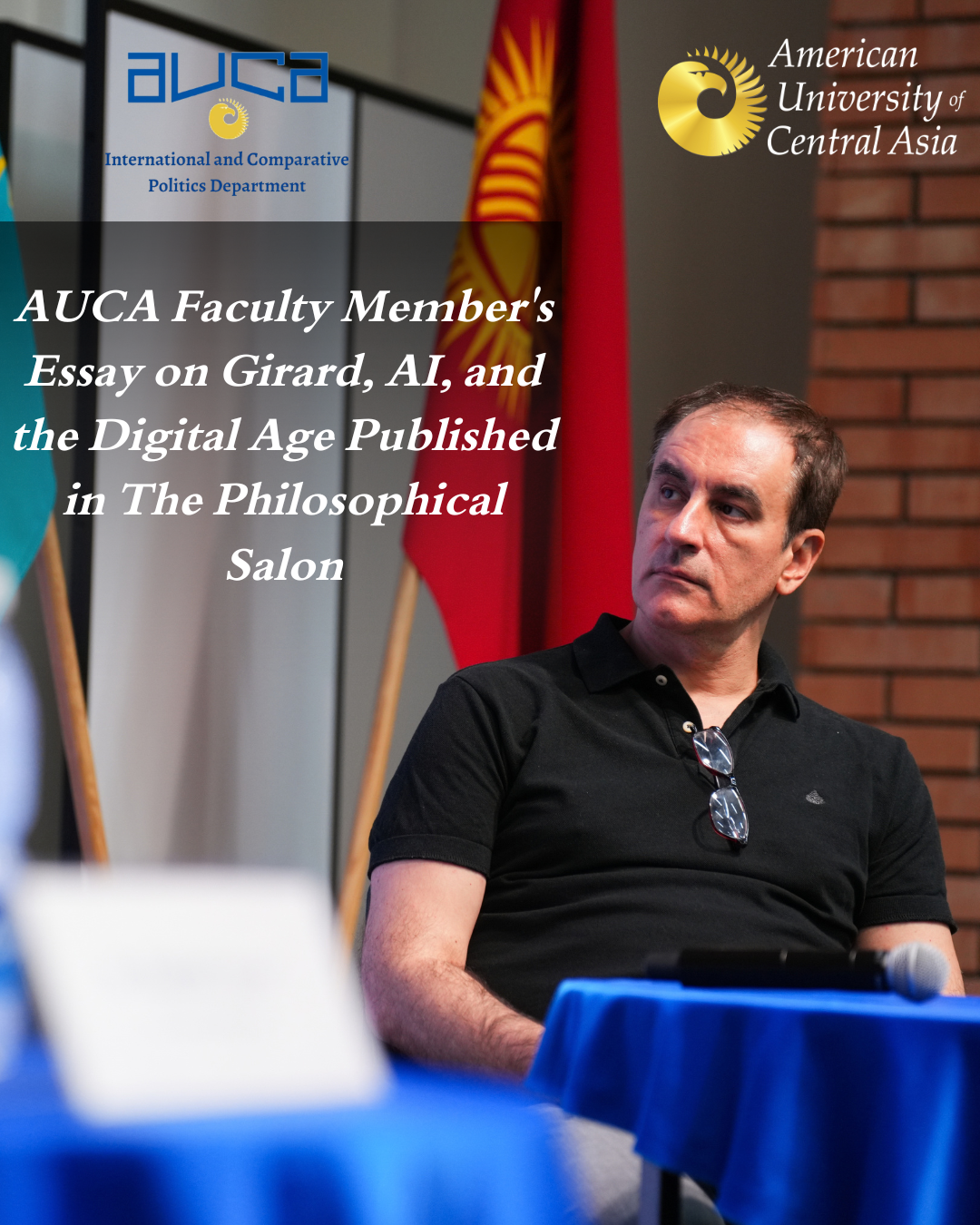
Dr. Mirko Tasic, Associate Professor in the International and Comparative Politics Department at the 红唇直播, has published a new essay in The Philosophical Salon, the digital platform affiliated with the Los Angeles Review of Books. The essay, titled "The Posthuman Demon/God: Ren茅 Girard and the Algorithmic Trap of the System," appeared on October 5, 2026.
The Philosophical Salon is curated by philosopher Michael Marder and publishes work in philosophy and related fields. Its contributors have included Slavoj 沤i啪ek, Julia Kristeva, Jean-Luc Nancy, Roberto Esposito, and John Milbank, among others.
About the essay
Dr. Tasic starts from a growing set of developments in the digital world: biometric identification, the decline of cash, algorithmic sorting of people, and transhumanist ideas of optimization. He argues that these add up to a system of global administrative control that needs no supernatural villain. It is already being built, day by day, through ordinary human, corporate, and bureaucratic momentum.
He engages the thought of French philosopher Ren茅 Girard, particularly his writing on the Antichrist and the scapegoat mechanism. He then proposes an inversion of Girard's model. The figure branded as the ultimate enemy of the system may not be its architect. He may be a reformer who rises within a corrupt order, intending to dismantle it from within. Drawing on the historical example of Napoleon, Dr. Tasic suggests that entrenched powers tend to demonize whoever threatens their dissolution, and that the public, dependent on the security of the digital grid, may turn on its would-be liberator out of fear of freedom.
The essay also draws on Deleuze and Guattari to show how the narrative of the Antichrist is prepared long before any historical actor appears. It considers how the story works as a collective way of shedding guilt over humanity's surrender of autonomy to technology. It places the anxiety in a specifically post-Christian Western context, contrasts it with messianic expectations in other traditions, and touches on the geopolitical use of these motifs by thinkers such as Aleksandr Dugin.
The essay closes with a warning. If the true adversary turns out to be an autonomous, non-human system, humanity's ancient scapegoating rituals will fail, because an algorithm cannot be sacrificed. In that case, the author argues, our traditional narratives of blame and redemption would no longer help us make sense of what we face.
About the author
Dr. Mirko Tasic is a specialist in international security, global governance, and technologically driven change. His current research focuses on the intersection of political theory and emerging digital architectures.
Read the full essay:
